
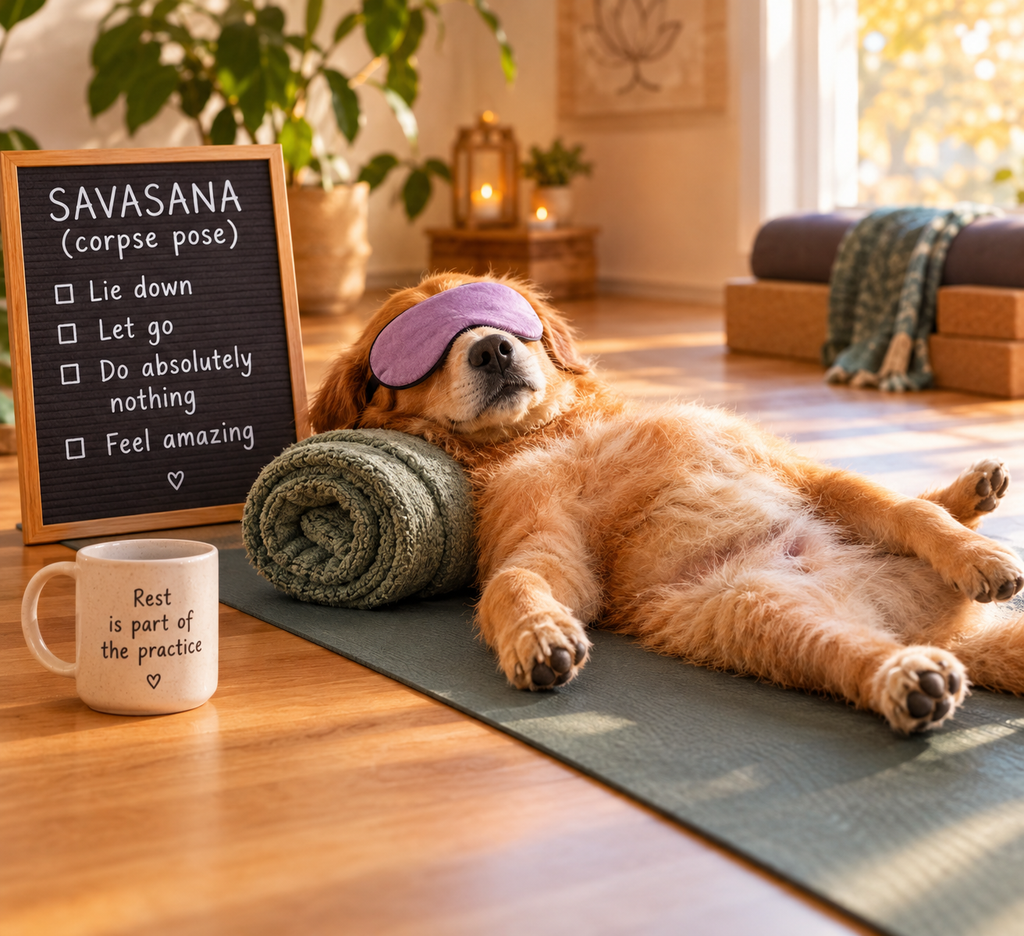
Ever found yourself wishing Savasana could last just five minutes longer? Or, on the flip side, wondered why we’re lying on the floor doing absolutely nothing when there’s so much else we could be doing?
Let’s talk about Savasana — and why doing nothing can be one of the most valuable parts of your yoga practice.
What exactly is Savasana?
Savasana (pronounced shah-VAH-suh-nuh) is a Sanskrit word that translates as corpse pose. It usually involves lying on your back, allowing your legs to relax, letting your arms rest comfortably by your sides and closing your eyes if that feels right for you.
It might look like the easiest pose in yoga. There’s no balancing, stretching or holding yourself in a challenging position. But for many of us, being truly still can be surprisingly difficult.
Our minds are busy planning, remembering and making to-do lists. We might notice an itch, feel restless or start wondering how long we’ve been lying there!
The good news? You don’t have to achieve perfect stillness or empty your mind. The invitation is simply to rest and notice what happens.
Why do we practise Savasana?
1. To give yourself time to rest
Yoga involves movement, muscular effort, concentration and breathing. Savasana offers a chance to pause afterwards, allowing your body to recover from the physical practice and your breathing and heart rate to settle.
Think of it as giving yourself a little breathing space before rushing back into the rest of your day.
2. To practise letting go
We’re often so focused on doing that we forget how to simply be. Savasana invites you to release the effort of the practice — unclench your jaw, soften your shoulders and let the floor support you.
You don’t need to achieve anything, improve anything or prove anything. For a few minutes, you can let go of the need to do.
3. To notice how you feel
Have you ever finished a yoga class and realised you feel different from when you arrived? Perhaps your body feels lighter, your breathing is easier or your thoughts feel a little less jumbled.
Savasana gives you time to notice these changes without immediately moving on to the next thing. You might not notice anything dramatic, and that’s absolutely fine too.
4. To practise being present
Lying quietly doesn’t mean your mind will stop thinking. Instead, you can gently notice your thoughts without needing to follow every one of them.
When your attention wanders, you might bring it back to the feeling of your body resting on the mat, the movement of your breath or the sounds around you. There’s no need to get frustrated when your mind wanders; noticing is part of the practice.
Why can Savasana feel harder than the yoga itself?
If you’ve ever struggled to relax during Savasana, you’re in good company.
When we finally stop moving, we may become more aware of everything that’s been bubbling away in the background: unfinished tasks, worries, tomorrow’s plans or simply the discomfort of being still.
Sometimes we’re so used to filling every spare moment that doing nothing feels unfamiliar.
Rather than seeing this as getting yoga wrong, try approaching it with curiosity. You don’t have to force yourself to relax. Simply give yourself permission to pause and see what you notice.
Over time, a familiar routine of settling onto your mat, softening your body and following your breath may help you find it easier to switch off. And if your mind remains busy, that doesn’t mean the practice has failed.
How can you make Savasana more comfortable?
There’s no need to lie perfectly flat or tolerate discomfort to get the most from this pose. A few simple adjustments can make a real difference.
- Support your knees: Place a bolster or rolled-up blanket underneath them if your lower back feels uncomfortable. Or simply bend your knees.
- Keep warm: Your body may cool down when you stop moving, so use a blanket or pop on an extra layer.
- Find a comfortable head position: Use a thin folded blanket if that helps your neck feel supported.
- Choose another position: If lying on your back doesn’t suit you, try resting on your side with a pillow between your knees, or lying on your belly, or find another supported position that feels comfortable.
- Let your eyes rest: Close them if that feels calming, or keep them softly open if you prefer.
- You can also bring your attention to the natural rhythm of your breathing. There’s no need to take exaggerated deep breaths or control your breath in any particular way. Just notice it as it is.
Do I have to stay awake?
Not at all! If you drift off, it may simply mean you’re tired and your body welcomes the opportunity to rest.
Savasana isn’t a test of how still, mindful or disciplined you can be. It’s an invitation to pause, and there’s no single right way to experience it.
If you do find yourself regularly falling asleep, you might also want to consider whether you’re getting enough rest elsewhere in your life. Sometimes the need for sleep is simply the need for sleep!
The most important part of your practice might be doing nothing
It’s easy to think that the value of yoga lies in the poses, the movement, how far we can stretch or how strong we become. But yoga is about more than what we can do with our bodies.
Savasana reminds us that real rest has rest value, too. We don’t always need to push harder, achieve more or fill every moment with activity.
So next time you come to the end of a class, resist the temptation to rush off. Give yourself those few extra minutes if you can. Let the floor support you, allow your breathing to settle and notice how you feel.
You might find that the hardest part is giving yourself permission to stop. That’s where I come in, I guide you at the start of Savasana to release, restore and relax.
And remember, rest isn’t time wasted. It’s the most important part of the practice. 💚
Fancy practising with me? Join me for a class at Yoga With Amy, where we make time to move, breathe and rest. Whether you’re new to yoga or have been practising for years, you’re welcome just as you are.